 COWARTU

1. The big question every voice actor is asking
Technology is moving faster than ever. AI is no longer only about data or coding. It writes content and makes images, and now it has walked straight into the dubbing and recording studio.
Today you can type a script into a website and get a clean, natural-sounding voice in a few seconds. Companies use these AI voices for e-learning courses, corporate videos, audiobooks, phone menus and even some advertisements.
So every voice actor is asking: "Is AI going to take my job?" The honest answer is that AI will take some jobs, but not the ones that matter most. Let's look at which work is moving to AI, which work will stay human, and what you should do about it.
2. Where AI stands today
Two things are happening at the same time. AI voice technology is growing very fast, and the demand for dubbed content in India is also exploding.
- The global AI voice generator market is expected to grow from about $4.2 billion to $20.7 billion by 2031 (MarketsandMarkets).
- India's AI voice market alone could reach around $914 million by 2030, one of the fastest-growing in the world (MarketsandMarkets).
- India now ranks 3rd in the world for anime viewership (share of people who watch anime), behind only Japan and China (GEM Partners, Anime Global White Paper 2026).
- In a 2026 survey of 1,379 voice actors by the US-based National Association of Voice Actors (NAVA), 21% said they had knowingly lost a job to an AI voice.
OTT platforms like Netflix, Amazon Prime and JioHotstar, along with anime platforms like Crunchyroll, are releasing more and more content in Hindi, Tamil and Telugu. To keep up, studios have started testing AI tools that can copy a voice and even try to match lip movements. The big selling point is simple: speed and low cost.
But here's the twist: faster and cheaper is not the same as better. When Amazon Prime used AI to dub some anime titles, viewers made fun of the flat, lifeless voices online, and some of those dubs were taken down. Audiences can tell when something is fake.
3. Where AI is winning: routine, low-cost work
AI has first taken over the part of the industry where clear information matters more than feelings. If a client only needs words read clearly, fast and cheap, AI is very hard to beat. This includes:
- E-learning modules that only need clear pronunciation
- Corporate training videos made for a company's internal use
- Low-budget ads and reels where speed matters more than quality
- IVR and customer care voices ("Press 1 for Hindi…")
In our view, a large share of this routine work will move to AI in the coming years. Here the client isn't paying for emotion. They're paying for quick delivery at the lowest price.
4. Where humans still win: emotion and depth
Voice acting is not just reading a script. It is giving life to words.
Think about an anime hero screaming in pain in the middle of a battle. A character's voice shaking with fear in a film's climax. Someone taking a deep breath before saying "I love you." These are the moments where AI still falls short. A trained human brings:
- Real pauses that carry meaning
- Breath that makes a character feel alive
- True emotion: the real crack of pain or shake of happiness in a voice
- Cultural feel: the local tone and "desi" touch that makes Hindi dubbing feel natural, not translated
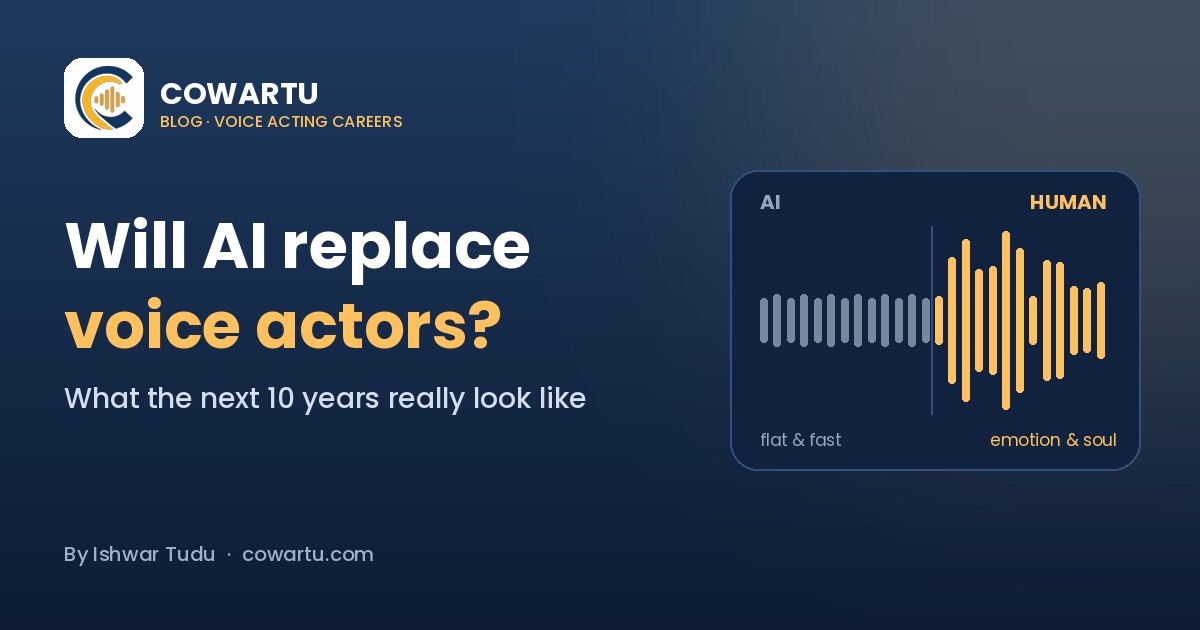
Machines can give a perfect voice. But they cannot put a soul into it.
5. The next 5–10 years: the market splits in two
The bottom tier (AI dominated): cheap, fast work. Average voice actors will be replaced here. If a beginner thinks "I'll work for very little money and build my name," that plan won't work, because AI will do it even cheaper.
The premium tier (human led): quality work with high trust. Big brands, big-budget films, top anime, video games and A-grade audiobooks need real emotion, because audiences only connect when they feel something real.
How safe is each type of voice work?
| Type of work | AI risk |
|---|---|
| IVR & phone menus | Very high |
| Corporate training & basic e-learning | High |
| Low-budget reels & social ads | High |
| Documentary narration & audiobooks | Medium |
| Big brand ads | Low |
| Film, OTT, anime & game dubbing | Low |
6. Money and job security: the good news
Voice actors who upgrade themselves will see their demand go up. When brands need quality and trust, they are ready to pay more. As the crowd that only "reads scripts into a mic" gets filtered out, truly talented people become more valuable.
Real data supports this. In the same 2026 NAVA survey where 21% lost a job to AI, 41% said their income grew in 2025, while 30% saw it fall. The industry isn't dying. It's separating skilled professionals from the rest.
AI is not the end of the voice industry. It is a filter. It removes people who are average and rewards people who treat voice acting as a real art.
7. Your voice, your rights
AI doesn't only compete with voice actors. Sometimes it copies them. The good news is that the law is starting to protect performers:
- India, 2024: the Bombay High Court protected singer Arijit Singh's voice and style from AI cloning tools.
- India, 2025–26: the Delhi High Court gave similar protection to Kumar Sanu (2025), and to Jubin Nautiyal and Sonakshi Sinha (2026), against AI misuse of their voice and likeness.
- USA, 2025: video game actors won a contract that requires clear consent before AI is used to copy their voice.
To protect yourself: read every contract carefully, look for words like "AI", "synthetic" and "perpetual", never give lifetime rights to your voice for a small payment, and don't upload long recordings of your voice to apps you don't trust.
8. Skills that make you AI-proof
If the future belongs to the premium tier, these are the skills to build:
- Emotional acting: feelings the listener can actually feel
- Voice modulation: changing pitch, pace and energy for every character
- Breath and pause control
- Lip-sync dubbing: matching the screen while acting naturally
- Script analysis and character building
- Clear Hindi and English articulation
- Professional skills: auditions, a demo reel, and handling clients
These skills don't come from watching a few videos. They come from practice, a trained teacher and honest feedback. And smart voice actors use AI only for the boring parts, like cleaning audio or organising work, while the performance stays 100% human.
Train with Cowartu, starting with just your smartphone
Cowartu is a voice acting and dubbing training platform built to give India's talented voices the training and opportunity they deserve. No mic or studio needed to begin.
Conclusion
In the next 5 to 10 years, routine voice work like corporate videos, IVR and basic e-learning will mostly move to AI. But wherever there is a need for real emotion, brand trust and true art, humans will lead.
So the real question isn't "Will AI replace voice actors?" It's "Will you train hard enough to be the voice AI can't replace?"
Frequently asked questions
Will AI completely replace voice actors?
No. AI is taking over simple, low-budget work. Films, anime, games, premium ads and audiobooks still need skilled humans.
Is voice acting still a good career in India?
Yes, if you train properly. Hindi and regional dubbing demand is growing because of OTT platforms and anime.
I'm a complete beginner. Is it too late?
Not at all. The market rewards skill, not seniority. A well-trained beginner can stand out quickly.
Do I need an expensive studio?
No. You can start practising with your smartphone in a quiet room. Skill matters far more than equipment at the start.